
The Industrial Internet of Things in the Artificial Intelligence Era: A Strategic Analysis of the United States Market
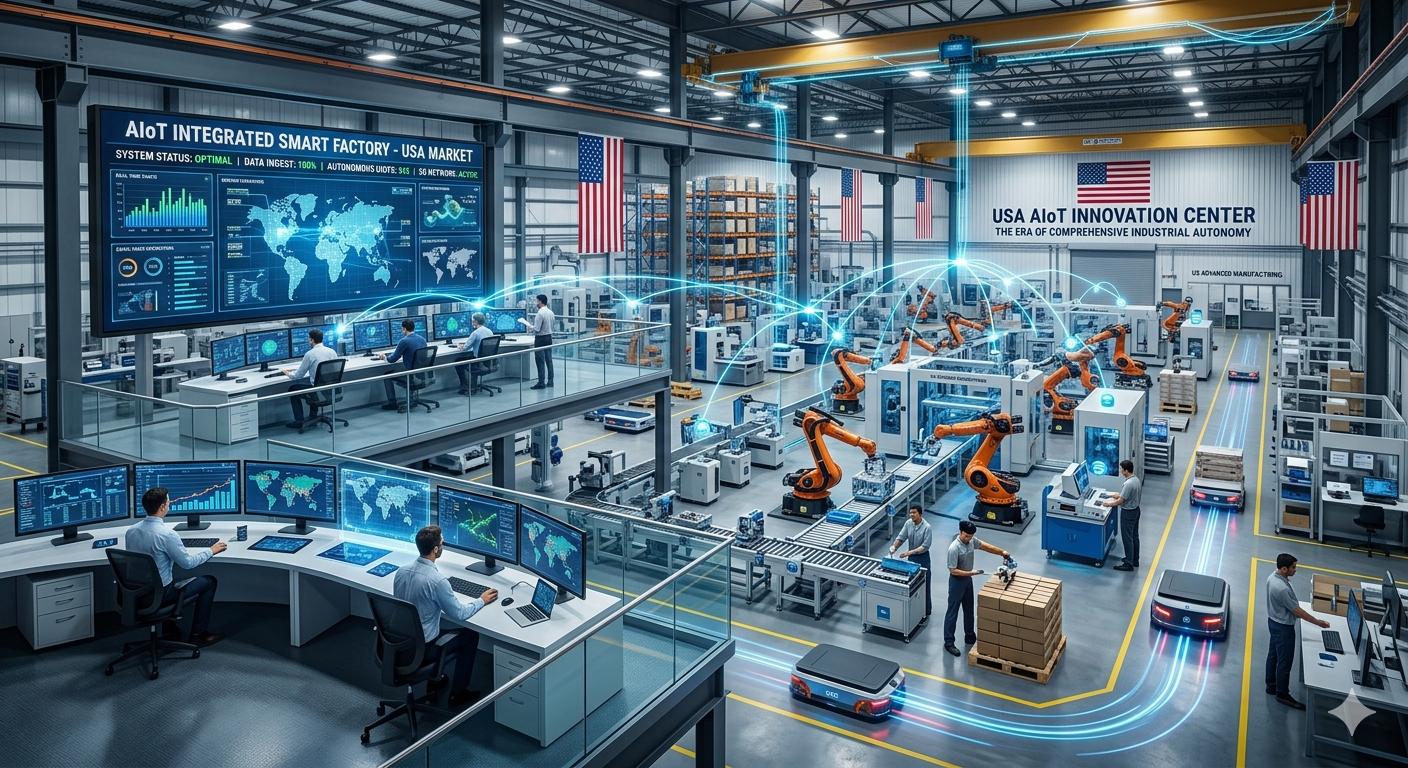
The Industrial Internet of Things in the Artificial Intelligence Era: A Strategic Analysis of the United States Market
The convergence of the Industrial Internet of Things (IIoT) and Artificial Intelligence (AI) has initiated a profound transformation within the United States industrial sector, marking the transition from traditional automation to a state of comprehensive industrial autonomy. This era, characterized by the seamless integration of ubiquitous connectivity and advanced cognitive computing, represents a pivotal shift in how American enterprises manage production, supply chains, and energy infrastructure. As organizations navigate the complexities of the mid-2020s, the synergy between hardware-centric IoT and software-centric AI—often termed "AIoT"—is serving as the primary catalyst for operational resilience, sustainability, and global competitiveness.
Economic Foundations and Market Trajectory in the North American Context
The United States industrial landscape is currently experiencing an era of unprecedented digital capitalization. The domestic industrial IoT market has transitioned from a phase of experimental adoption into a period of mature, large-scale implementation. In 2024, the United States industrial IoT market reached a valuation of approximately USD 135.6 billion. This valuation is not merely a reflection of equipment procurement but indicates a deeper systemic investment in the digital architecture required to sustain modern industrial operations. Projections indicate a robust growth trajectory, with the market expected to expand to USD 568.9 billion by 2033. This growth represents a compound annual growth rate (CAGR) of 17.1% from 2025 to 2033, a figure that underscores the strategic priority placed on digital transformation by U.S. industrial leaders.
Quantitative Analysis of the US Industrial IoT Market (2024-2033)
The momentum within the U.S. market is driven by a confluence of factors, including the imperative to enhance operational efficiency, the necessity of predictive maintenance, and the integration of 5G infrastructure. The following data summarizes the expected economic progression:
| Market Metric | 2024 Value | 2033 Forecast | CAGR (2025-2033) |
|---|---|---|---|
| U.S. Industrial IoT Market Size | USD 135.6 Billion | USD 568.9 Billion | 17.1% |
| Global AI in IoT Market Size | USD 1.35 Billion | USD 40.5 Billion | 28.53% |
| U.S. Industrial Robot Installations | 44,303 Units (2023) | N/A | 12% (YoY Growth) |
| Global Wireless IIoT Sensors | N/A | USD 16.1 Billion (2032) | 12.3% |
This economic expansion is mirrored by the rapid proliferation of connected devices. By 2025, the number of industrial IoT devices globally is expected to reach 152 million, with North American industrial establishments projected to maintain an average of 365 IIoT devices per facility. This density of instrumentation provides the granular data necessary for AI models to move beyond rudimentary pattern recognition into complex, autonomous decision-making.
Regional Growth Dynamics and Global Competitiveness
While the United States remains a mature market focused on optimizing existing IIoT architectures with advanced edge analytics, it faces a dynamic global landscape. The Asia-Pacific (APAC) region is currently the fastest-growing market for AI in IoT, driven by massive manufacturing expansion in China and India. Specifically, India’s industrial IoT market is expected to grow at a CAGR of 29% through 2030, the fastest in the world. In contrast, the European market is anticipated to witness a CAGR of over 22% during the same period, largely due to stringent sustainability and energy management regulations.
Despite these high growth rates in emerging markets, North America remains the dominant region in terms of market share for AI in IoT, holding a significant portion of the global valuation. U.S. firms report approximately 20% higher efficiency in asset performance management compared to global averages, a testament to the sophistication of domestic software integration and cybersecurity frameworks. This leadership is further bolstered by a 20% average increase in operational efficiency observed by firms adopting full-stack industrial automation solutions.
The Technological Convergence: Bridging Connectivity and Cognitive Computing
The efficacy of industrial IoT in the AI era is fundamentally dependent on the quality and velocity of data transmission. The evolution of AI from centralized cloud-based models to decentralized edge-based intelligence has necessitated a radical reimagining of industrial connectivity.
The Role of High-Performance Connectivity: 5G and Beyond
The integration of 5G technology has served as a critical enabler for real-time industrial applications. By the end of 2023, North America recorded 197 million 5G connections, representing 29% of all cellular connections in the region and marking a 64% year-over-year increase. Forecasts suggest that by 2028, North America will host 700 million 5G connections, accounting for over 80% of total regional connections.
The technical specifications of 5G—specifically its ultra-low latency and high bandwidth—are essential for high-stakes industrial environments. For instance, autonomous mobile robots (AMRs) and remote-controlled heavy equipment in mining or logistics require near-instantaneous feedback loops to operate safely and efficiently. The presence of 17 commercial 5G networks in North America as of early 2024 provides the foundational infrastructure for these advanced IIoT deployments.
Edge Computing and the Decentralization of Intelligence
As the volume of data generated by industrial sensors grows, the traditional model of transmitting all data to the cloud for processing has become increasingly untenable due to latency, bandwidth costs, and security concerns. This has led to the rise of Edge AI, where machine learning models are deployed directly on industrial gateways or even on individual sensors.
The software segment is the highest contributor to the AI in IoT market, growing at a CAGR of 27.89%. This segment includes critical functions such as:
- Real-time Streaming Analytics: Processing sensor data "in-motion" to detect anomalies within milliseconds.
- Data Management and Contextualization: Transforming raw voltage or vibration signals into meaningful industrial metrics.
- Network Bandwidth Management: Prioritizing critical safety and control data over routine monitoring streams.
- Edge Security: Implementing localized encryption and authentication to protect the perimeter of the industrial network.
Generative AI: Redefining the Industrial Intelligence Frontier
The emergence of Generative AI (GenAI) represents a secondary, perhaps more disruptive, wave within the industrial sector. While traditional AI excels at identifying correlations in structured numerical data, GenAI possesses the capability to synthesize and interpret unstructured data, such as text, images, and video, creating a more comprehensive "situational awareness" for industrial systems.
Integration of Unstructured Data and Knowledge Graphs
A significant challenge in industrial operations is that a vast amount of critical information resides in unstructured formats, such as machine operator logs, maintenance records, and technical service manuals. Traditional AI models are often blind to this context. Generative AI addresses this gap by incorporating these diverse data sources to fine-tune predictions.
For example, when a traditional AI model predicts an equipment failure based on vibration data, a Generative AI system can cross-reference that prediction with historical maintenance logs to determine if a specific part was recently replaced or if a recurring issue was noted by technicians. This allows the system to suggest specific operational strategies to extend equipment life and minimize unplanned downtime. In smart factories, GenAI helps onsite technicians diagnose problems faster by narrowing in on likely causes based on both sensor data and the operating history found in technician notes.
Synthetic Data Generation and Model Training Efficiency
One of the most innovative applications of Generative AI in the industrial context is the creation of synthetic data. Training robust AI models requires massive datasets, particularly for rare failure events that occur infrequently in the real world. Generative AI can simulate these failure scenarios, creating high-fidelity synthetic data to train predictive models without the need for actual equipment breakdowns.
The automotive and aerospace industries have leveraged this capability to dramatic effect. Bosch, for example, utilized Generative AI to generate synthetic image data for its visual inspection systems, reducing the development time from years to just six months while simultaneously boosting annual productivity. This capability allows engineers to test thousands of prototypes and operational scenarios through digital twin simulations before a physical asset is ever constructed.
| Generative AI Use Case | Industrial Benefit | Economic/Operational Impact |
|---|---|---|
| Product Design & Development | Rapid testing of thousands of prototypes via generative models. | Accelerated time to market; reduced R&D costs. |
| Predictive Maintenance | Combining sensor data with maintenance logs for deep diagnostics. | 67% reduction in unexpected breakdowns; 50% lower maintenance costs. |
| Knowledge Management | Natural language querying of technical manuals and past fixes. | Rapid retrieval of instructions; upskilling of junior technicians. |
| Synthetic Data Production | Generating images/logs for AI model training. | Cuts system development time by 50-80%. |
| Supply Chain Optimization | Blending real-time inputs for demand forecasting. | Reduced stockouts and excess inventory; improved logistics resilience. |
Sectoral Transformations: The Smart Factory and the Autonomous Supply Chain
The application of AI-enhanced IIoT is driving specialized transformations across various industrial verticals, with manufacturing and logistics representing the most significant areas of impact.
Manufacturing Excellence: From Automation to Autonomy
Manufacturing is the highest contributor to the AI in IoT market, expected to grow at a CAGR of 28.43% through 2033. The goal for U.S. manufacturers is the development of fully automated data management and production solutions that can adapt to changing conditions without human intervention.
In the automotive sector, Ford and BMW have implemented AI-driven computer vision systems to enhance quality control. Ford utilizes these systems to identify imperfections in seat fabrics and body panels, replacing traditional human inspection with automated systems that catch defects earlier and reduce material waste. These systems can detect flaws and abnormalities that might be missed by the human eye, enabling quick intervention and reducing recall rates.
The economic value of these implementations is substantial. The adoption of asset condition monitoring and predictive maintenance can save companies globally an estimated USD 388 billion due to a 5% increase in overall productivity. Companies like Rolls-Royce and GE have successfully deployed predictive maintenance for turbine engines, while Hyundai uses AI for production optimization to maintain a competitive edge in manufacturing efficiency.
Logistics and Fulfillment: Real-Time Orchestration in a High-Density Data Environment
The logistics sector is uniquely positioned to benefit from AI and IIoT due to its high data density. A single delivery vehicle can produce over 25,000 data points daily, and a mid-size warehouse can generate 2 to 5 million scan events monthly. Despite this, the AI adoption rate in logistics currently stands at 35%, trailing retail and financial services. However, the sector offers an average ROI of 190% for successful AI deployments, providing a compelling financial incentive for adoption.
Leading U.S. logistics firms are leveraging these technologies to address rising operational costs and shifting customer demands:
- FedEx: The company is undergoing an AI-driven transformation, integrating machine learning across its supply chain. Key initiatives include the "Shipment Eligibility Orchestrator," which dynamically routes packages in real-time, and the "Hold-to-Match" solution, which optimizes last-mile delivery by consolidating shipments to the same address. FedEx's "Surround" platform uses AI and sensor technology for real-time monitoring and proactive intervention.
- UPS: The "ORION" system (On-Road Integrated Optimization and Navigation) serves as a hallmark of AI-driven efficiency, saving millions of dollars daily by optimizing delivery routes.
- GXO Logistics: As a leading pure-play contract logistics provider, GXO utilizes technologically advanced supply chain solutions to enhance resilience and growth for blue-chip brands, earning recognition as one of America's most reliable companies.
The logistics sector also faces significant implementation barriers. Legacy Transport Management Systems (TMS) and Warehouse Management Systems (WMS) often lack modern API layers, making data extraction difficult. TMS/WMS integration can consume 30-40% of the total cost of an AI project. To overcome this, leading firms like Maersk and DHL have built logistics data platforms that act as abstraction layers, decoupling AI development from the constraints of legacy systems.
| Logistics Company | AI/IIoT Application | Reported Impact |
|---|---|---|
| FedEx | Digital Twin & Predictive Maintenance | 10% cost reduction; 20% reduction in downtime. |
| UPS | ORION Route Optimization | Millions of dollars saved daily; reduced fuel consumption. |
| DHL | Route Optimization & Demand Forecasting | 15% faster delivery; 18% lower inventory costs. |
| Walmart | AI Inventory System | Millions of dollars saved through optimized stock levels. |
| Maersk | AI Compliance System | 25% reduction in fines through proactive monitoring. |
Energy Infrastructure: Powering and Optimizing the AI Revolution
The relationship between AI and the energy sector is characterized by a fundamental duality: AI is a massive consumer of electrical power, yet it is also the most potent tool available for optimizing the production and distribution of that power.
The Dual Challenge of Energy Consumption and Efficiency
The rise of AI infrastructure in the United States is driving an unprecedented surge in electricity demand. Hundreds of planned data centers have power requirements exceeding 300 MW each, with some surpassing 1 GW. To meet this demand, the U.S. will likely require 75–100 GW of new generating capacity by the early 2030s. This growth is so significant that a July 2025 White House directive, "Winning the Race: America’s AI Action Plan," called on the private sector to build the vast energy infrastructure needed to power the AI era.
Simultaneously, AI is transforming energy operations. In early 2024, approximately 55% of companies reported using IoT technology for energy monitoring. In the EU, 35% of manufacturing companies use IoT for energy consumption management, and IoT-enabled smart thermostats in HVAC systems can achieve up to 10% energy savings. AI is also being used to analyze complex datasets—such as weather patterns and land use—to identify the best locations for wind farms and solar plants.
Smart Grids and Renewable Integration
The integration of renewable energy sources remains a primary challenge due to their inherent volatility. AI-powered smart grids address this by simulating future power demand fluctuations based on IoT sensor data, assisting energy providers in outage prevention. AI also optimizes output for running plants by adjusting operations based on weather forecasts and demand cycles, leading to greater power generation from the same assets.
Despite the potential, a 2024 BCG survey found that nearly 70% of energy company leaders were dissatisfied with their AI progress. This "inflection point" requires companies to rethink their approach, moving past experimental pilots toward scaling AI across the entire organization to turn technology into a competitive edge.
Architectural Frameworks for Scalable Digital Transformation
The primary technical hurdle for industrial businesses is the presence of fragmented, siloed data. The traditional "Industry 3.0" architecture, characterized by point-to-point integrations and rigid hierarchies, has proven insufficient for the needs of AI.
The Unified Namespace (UNS) and the End of Data Silos
The Unified Namespace (UNS) has emerged as a transformative architectural concept designed to address why 74% of manufacturing digital transformation projects stall. Rather than a specific piece of software, the UNS is a conceptual framework and model for organizing data across an entire enterprise.
The UNS treats every component of the enterprise—Programmable Logic Controllers (PLCs), SCADA systems, Manufacturing Execution Systems (MES), and Enterprise Resource Planning (ERP)—as a "node" in an ecosystem. These nodes publish data to a centralized broker, creating a "single source of truth" that is accessible to any other node that requires it. This eliminates the need for complex, individual connections between systems. For example, if a company adds a new inventory management system, it can simply "plug" into the UNS and begin consuming the data it needs without reconfiguring the underlying machines.
The UNS typically follows a semantic hierarchy based on the ISA-95 standard: Enterprise Level, Site Level, Area Level, Line Level, Cell Level. This structure ensures that data is contextualized and intuitive, allowing anyone in the organization to find the information they need.
Protocol Standardization: MQTT and Sparkplug B
The technical backbone of the Unified Namespace is often the MQTT (Message Queuing Telemetry Transport) protocol. MQTT is a lightweight, publish-subscribe messaging protocol designed for constrained devices and low-bandwidth, high-latency networks. When combined with the Sparkplug B standard, MQTT provides a "plug-and-play" capability that allows industrial devices to be automatically discovered and integrated into the UNS with their data already formatted and contextualized.
This architecture is essential for "Agentic AI"—AI systems that can not only analyze data but also act as autonomous agents, subscribing to data streams, making decisions, and publishing commands back to the factory floor in real-time.
The Cloud and Edge Ecosystem: A Comparative Analysis of Hyperscalers
Industrial businesses in the U.S. market rely heavily on the "Big Three" cloud providers—Amazon Web Services (AWS), Microsoft Azure, and Google Cloud Platform (GCP)—each of which has developed specialized suites for IIoT and AI integration.
| Provider | Industrial IoT Platform | Core AI Integration Features | Strategic Advantage |
|---|---|---|---|
| AWS | IoT SiteWise | IoT TwinMaker (Digital Twins); Amazon Monitron (ML maintenance). | Broadest set of specific IoT services; strong for established AWS-first shops. |
| Microsoft Azure | Azure IoT Operations | Azure Digital Twins; Deep integration with Dynamics 365 and Power Platform. | Best for organizations using the Microsoft ecosystem; "citizen developer" friendly. |
| Google Cloud | Manufacturing Data Engine | Vertex AI (Advanced ML); BigQuery (Analytics at scale); Visual Inspection AI. | Superior for data-heavy, AI-first strategies; competitive pricing for massive datasets. |
AWS SiteWise focuses on the collection and modeling of industrial data, while Azure’s strength lies in its comprehensive security framework (Azure Sphere) and its ability to empower non-technical staff to build applications via the Power Platform. Google Cloud, however, is often the choice for companies focused on high-end machine learning, leveraging its Vertex AI platform to train and deploy sophisticated models.
Governance, Security, and Public Policy
The U.S. government has recognized the strategic importance of the industrial IoT and AI sectors, implementing significant policy measures to ensure national security and economic resilience.
Legislative Catalysts: The CHIPS and Science Act
Passed in 2022, the CHIPS and Science Act represents one of the most significant government interventions in the U.S. technology sector in decades. The act allocates USD 280 billion toward boosting domestic scientific research and semiconductor manufacturing capacity.
The primary impact on the industrial IoT sector includes:
- Domestic Semiconductor Production: USD 52.7 billion in federal funding is designated to bring chip manufacturing back to the U.S., reducing reliance on foreign suppliers like TSMC in Taiwan. This ensures a stable supply of the microprocessors and Application-Specific Integrated Circuits (ASICs) required for IoT devices and AI processing.
- Research and Development: USD 200 billion is earmarked for research into AI, quantum computing, and robotics.
- Supply Chain Security: The act aims to create a more resilient semiconductor supply chain, which is crucial for modern products ranging from automobiles to weapon systems.
The CHIPS Act is expected to put the United States on a path to producing nearly 30% of the global supply of leading-edge chips by 2032, a significant increase from its current share of about 12%.
Cybersecurity Standards and NIST Frameworks
As industrial systems become increasingly connected, they also become more vulnerable to cyber threats. The IoT Cybersecurity Improvement Act of 2020 required the National Institute of Standards and Technology (NIST) to publish standards and guidelines for the management of IoT devices. The resulting NIST SP 800-213 series provides comprehensive guidance for establishing device security requirements, including secure device enrollment, authentication, and encryption.
For industrial manufacturers, cybersecurity is no longer just a technical requirement but a core business strategy. AI-powered cybersecurity systems are now being used to detect unusual network activity or suspicious behavior in real-time, learning from past attacks to adapt to new threats.
Supporting the Mid-Market: The Role of the MEP National Network
While large corporations have the resources to navigate digital transformation, small and medium-sized manufacturers (SMMs) often face significant barriers. The Manufacturing Extension Partnership (MEP) National Network plays a critical role in helping these smaller firms adopt automation, improve cybersecurity, and thrive in the AI era. MEP centers provide strategic guidance, helping SMMs comply with NIST 800-171 frameworks and access supply chain solutions through supplier scouting.
Socio-Technical Challenges and the Future of Industrial Work
The transition to an AI-driven industrial model is not without its challenges, many of which are human rather than technical.
Bridging the Skills Gap and Workforce Literacy
The adoption of AI and IIoT necessitates a fundamental reskilling of the industrial workforce. In the logistics sector, for instance, 68% of warehouse operators identify workforce digital literacy as a primary barrier to AI deployment. Workers must transition from performing manual tasks to supervising autonomous systems and interpreting AI-generated insights.
Generative AI offers a partial solution to this problem by acting as a "knowledge bridge." By providing personalized work instructions and natural language access to technical documentation, GenAI can empower less experienced technicians to service complex equipment and increase the productivity of senior staff.
The Path to ROI: Overcoming "Pilot Purgatory"
Many companies find themselves trapped in a cycle of "pilot purgatory," where they launch numerous AI and IoT pilots but fail to achieve scale or significant ROI. This is often due to a lack of alignment between technology and business value. A 2024 Accenture report suggested that companies with a clear, strategic AI plan realize their return on investment twice as fast as those without one.
Key factors for successful scaling include: High-Quality Data Foundation (curated, contextualized datasets), Organizational Change Management, and Human-Centric Design (tailoring solutions to worker needs).
Conclusions and Strategic Recommendations
The industrial landscape of the United States in the AI era is defined by the move toward "Autonomous Everything." The integration of IIoT and AI is no longer a peripheral trend but the central engine of industrial productivity. The market data, legislative support, and technological advancements all point toward a future where the most successful industrial businesses will be those that can most effectively turn data into actionable intelligence.
For professional peers and industrial leaders, the following conclusions emerge from the current state of the market:
- Infrastructure is Non-Negotiable: The transition to 5G and the adoption of architectures like the Unified Namespace (UNS) are prerequisite steps for scalable AI deployment.
- Generative AI is the "Missing Link": The ability to bridge the gap between structured sensor data and unstructured human expertise via Generative AI is the most significant development in industrial intelligence since the advent of machine learning.
- Policy and Security are Intertwined: The CHIPS Act and NIST standards provide a framework for a more secure and resilient domestic industrial base.
- Human Capital is the Ultimate Bottleneck: Success requires a commitment to digital literacy and the development of intuitive, human-centric AI interfaces.
In summary, the United States market for industrial IoT in the AI era is robust, well-funded, and technically sophisticated. However, the true winners will be those who move beyond the "technological hype" and focus on the hard work of data contextualization, architectural standardization, and organizational transformation. The goal is a resilient, autonomous, and sustainable industrial ecosystem that can thrive in the face of global economic and environmental challenges.
Tags: IIoT, Artificial Intelligence, AIoT, Industrial Autonomy, Digital Transformation, US Market Analysis, Predictive Maintenance, 5G, Edge Computing, Generative AI, Unified Namespace, Smart Manufacturing, Supply Chain Optimization, Logistics, Energy Infrastructure, CHIPS Act, Industry 4.0, Cybersecurity, Edge AI, Semiconductor Industry