
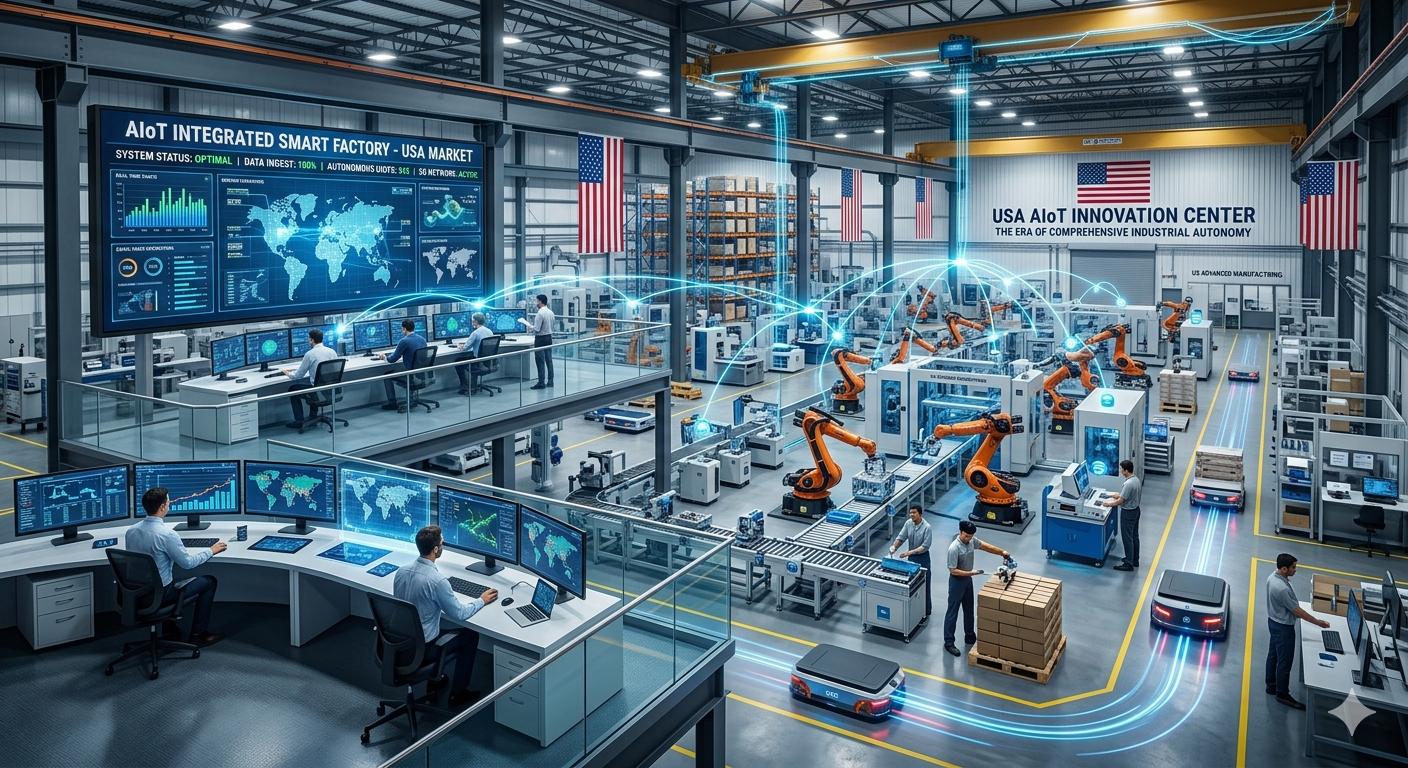
The Industrial Internet of Things in the Artificial Intelligence Era: A Strategic Analysis of the United States Market
This strategic analysis explores the convergence of the Industrial Internet of Things (IIoT) and Artificial Intelligence (AI) within the United States. It details the transition from basic automation to comprehensive industrial autonomy, driven by the "AIoT" synergy. Key highlights include: Economic Growth: The U.S. IIoT market is projected to grow from $135.6 billion in 2024 to $568.9 billion by 2033, a CAGR of 17.1%. Technological Shifts: The move toward Edge AI, 5G connectivity, and the Unified Namespace (UNS) architecture is eliminating data silos and enabling real-time decision-making. Generative AI Impact: Beyond traditional analytics, Generative AI is identified as a "knowledge bridge" that interprets unstructured data (like maintenance logs) and creates synthetic data to train predictive models. Sectoral Gains: Deep dives into Manufacturing (Ford, BMW) and Logistics (FedEx, UPS, DHL) showcase how AIoT reduces downtime, optimizes delivery routes, and enhances quality control. Policy & Security: The report emphasizes the role of the CHIPS and Science Act in securing semiconductor supply chains and the necessity of NIST cybersecurity frameworks to protect connected industrial assets. The analysis concludes that while the technology is mature, the ultimate bottleneck for U.S. industry is workforce digital literacy, requiring human-centric AI design and massive reskilling.
Tags: IIoT, Artificial Intelligence, AIoT, Industrial Autonomy, Digital Transformation, US Market Analysis, Predictive Maintenance, 5G, Edge Computing, Generative AI, Unified Namespace, Smart Manufacturing, Supply Chain Optimization, Logistics, Energy Infrastructure, CHIPS Act, Industry 4.0, Cybersecurity, Edge AI, Semiconductor Industry